Showing posts with label george ferguson. Show all posts

Thursday, 12 November 2009

The Arena - Disconnected Thinking?

It seems that there is now a serious push on to site an Arena (circle below) at Ashton Vale near the site now allocated for a new football stadium (rectangle below), with the Bristol Evening Post once again acting as cheerleader. Bristol's current political leaders all seem to be in favour of an Ashton Vale Arena, partly on the grounds that there is a 'synergy' between the Football Stadium and an Arena in terms of their transport infrastructure requirements, which is true up to a point.


View Arenas and Stadiums in a larger map

But an Arena isn't quite the same as a football stadium, mainly because it is likely to be staging events far more frequently and so having a much more significant impact in transport terms. The inescapable reality is that an Ashton Vale Arena will be accessed overwhelmingly by car even if the Ashton Vale BRT is developed, whereas the site previously envisaged for an Arena near Temple Meads could really make good use of our rail infrastructure and would be much more accessible by walking, cycling and bus due to its central location.


Land at Ashton Vale as it is now, following wanton destruction of trees earlier this year.

George Ferguson has been quick to speak out against the Ashton Vale proposal for this reason. This blog has had its differences with George in the past but once again he is saying clearly and loudly what desperately needs to be said. If we are even half serious about becoming a Green Capital or even just a Sustainable City then we need to think seriously about the transport implications of such iconic new developments as the Arena. Quite apart from the number of trips generated the character of the accessibiltiy of the Arena will send out signals about the future character of Bristol as a whole.

One only has to visit Cardiff Millenium Stadium to see the extent to which its proximity to Cardiff Central Station and its generally central location in the city is the key to its accessibility. Think of the 'synergy' between an Arena at Temple Meads and our rail services, which would receive a big boost during otherwise off-peak periods. The infrastructure and the capacity is there already and has the potential to be increased. Admittedly there is the posibility of some limited rail access being developed near Ashton Vale but this would be out on a limb rather than at the heart of the region's rail network and simply wouldn't have the capacity to replace more than a token amount of car journeys.


So once again those of us who care about the future direction must add our voices to that of George Ferguson and try to point out the contradictions between an Arena at Ashton Vale and a sustainable future for Bristol. Having the Football Stadium at Ashton Vale, just 750 metres further out than the existing football stadium, is one thing but an Arena that will draw crowds from the whole of Greater Bristol and well beyond is something else.

Saturday, 19 September 2009

Twenty's Plenty Needs You

I know I covered this just two weeks ago but this is IMPORTANT and needs action from all of us. As you may have noticed I'm generally pretty cynical about what Bristol City Council do in the name of sustainable transport and in this case too they are set to make a fundamental error. But this time it really matters because the 20 mph concept is our best chance, perhaps our only chance, of making a real change to the character of our streets so that ultimately they are no longer thought of as inherently dangerous places for people on foot or on bicycles.


The A420 Church Road, 20 mph in Redfield, Bristol.

As I explained before the main issue is the proposed exclusion of so many streets within the proposed 20 mph pilot areas. We know that the highway engineers are generally hostile to the idea of 20 mph areas and I suspect the proliferation of excluded streets is their way of undermining the scheme. We also know that some Councillors, notably Executive Member Jon Rogers, are very keen to get 20 mph implemented and he is on record as being unhappy with the number of excluded streets.

Now you may think 'why doesn't Jon Rogers, our elected representative, just tell the officers to cut the excluded streets?'. Well it seems that the levers of power aren't that simple or direct. He cannot do this alone and needs our support. We need to demonstrate the extent of popular support for the 20 mph concept and opposition to the excluded roads. And we need to do it by the end of this month when the formal consultation comes to an end.


One of our allies in this is George Ferguson, whose 'By George' column in today's Evening Post makes the case very well. I know I've had a pop at George on many occasions but that's just the iconoclast in me. In mostly makes a lot of sense and makes it very eloquently, especially in this case. To quote a few salient points from George's piece:-

"Having given the (20 mph) area a clear boundary, the document then complicates the issue by suggesting leaving certain routes through the area at the current 30mph limit. The fact is that these key routes are also key cycling and walking routes, and go past some of the seven primary schools within the area.

The trouble with traffic measures is that they are generally planned by highway engineers, who – however well-meaning – tend to think in terms of roads and traffic flow, and have very different criteria from those of us who occupy the streets for shopping and walking to school or to work and who regard them as social territory."

Great stuff. But we need more support and that means YOU. I know, we're all busy, etc. So I'm going to make it easy. Below is my own submission. Please use it as a template for your own comments. Delete anything you're uncomfortable with, add anything you think is missing, but PLEASE send something to 20mph@bristol.gov.uk (and copy it to Jon Rogers and your local councillors) and please do it now.

I strongly support the general principle of 20 mph as the general speed limit for all residential and shopping areas in Bristol.

The benefits are numerous, including of course less danger and intimidation of pedestrians and cyclists, easier and safer crossing of streets, less noise and pollution, less stress and even less traffic. The costs could be minimal if signing were kept to a minimum.

I would like to see the introduction of 20 mph over the whole of Bristol's residential areas, or at the very least the whole inner city where streets are generally narrower and/or heavily parked. I do not see the point in limiting it to two pilot areas since this increases the perimeter to area ratio so requiring more signing at more public expense for a given area.

However the major flaw in the current proposals is that the pilot areas have 'excluded' streets. In most cases these are the streets which most need lower speeds, where danger and intimidation is greatest, where most crossing movements take place, where people shop, walk and cycle, where schools are accessed and where noise, pollution and stress are greatest.

Excluding these streets will totally undermine the stated purpose of the 20 mph scheme. It will greatly increase the amount of signing required and hence the cost of the scheme and it will the create confusion by making it unclear whether a particular street is 20 mph or 30 mph without constant reference to signs which is impractical and a dangerous distraction in urban areas.

Apart from clearly non-residential roads like Easton Way there should be no exclusions within the 20 mph areas. In practice actual speeds will vary around the 20 mph mark according to local conditions, as they should, and on some streets the average may be significantly higher, but even speeds slightly above 20 mph will be a big improvement on speeds slightly above 30 mph.

Getting the 20 mph scheme right is of fundamental importance for the credibility of Cycling City, the Council's Walking Strategy and indeed the Council's overall 'Green' aspirations. The current proposals with the excluded streets have already been widely criticised and there can be little doubt that a 20 mph based on the current proposals will be seen as a failure of nerve on the part of the Council.

Thursday, 9 July 2009

St George and the Dinosaur

It's been interesting to observe George Ferguson's manoeuvring on the Ashton Gate Tesco supermarket proposal. Back at the beginning of June George was giving the idea very conditional support, saying
"If we're just going to end up with a big shed and whopping car park, then the answer is 'No'. "But if Tesco are prepared to do something really special, an exemplar scheme which is carbon-zero rated, which has mixed use and which puts Tesco at the heart of a community, then I think you could end up with a much better, more profitable scheme."
If only they'd had the sense to hire George, he would surely have sorted them out with something suitably community friendly. But they didn't and in due course the entirely predictable plans for a big shed and whopping car park appeared. By June 24th George is evidently losing patience with the developers. It's reported that he supports the football club in getting high value for the site in order to make its new stadium work, but any supermarket should be part of a mixed-use community if it was to find favour with him.
"They have to grow up and recognise that that form of supermarket is a dinosaur."

Still BCFC and Tesco didn't take the hint and pressed on with their dinosaur plans. Meanwhile opposition to the Tesco plan was growing in George's manor and the inaugural meeting of BERATE (Bedminster Residents Against Tesco's Expansion into Ashton Gate) was coming up, so time for another subtle position shift. At the meeting on 3rd July George said

“There is nothing like a major threat to its future to galvanise a community. This is an appalling proposal – another giant shopping shed set in a massive sea of car parking. The potential economic and environmental damage to this area is immense."

"I fully recognise the importance of Bristol City’s success but it is quite wrong to imply that a new supermarket is something to do with the new stadium or the World Cup – the two issues have to be de-coupled. It is inappropriate and legally dubious to consider the applications for the new stadium and the new supermarket simultaneously”.
Now that last point, the importance of "de-coupling" the two planning issues (Tesco and the new stadium), is a very sound one and I'm entirely in agreement. As George says, it would be "inappropriate and legally dubious" to consider the two issues as if one was conditional on the other. But of course we know that that sort of thing happens all the time with Bristol City Council.

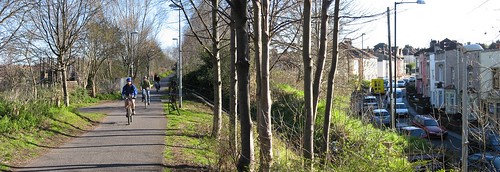
Indeed George may well be mindful of a very recent example concerning the redevelopment of the old Chocolate Factory in Greenbank, where the city council have decided to sell a plot of Railway Path land (the long hedgerow shown below) to the developer, Squarepeg, in contravention of its own Parks and Open Spaces policies and the results of extensive public consultation. The reason given by the council is that the planned redevelopment of the Chocolate Factory depends on the land sale (because that's what Squarepeg claimed, in exactly the same way as BCFC claim that their plans for a new stadium depend on the Tesco development proceeding).


Inexplicably there appears to be no record of George Ferguson speaking out against this earlier travesty of natural justice. Yet he must surely have known all about it, seeing as he is the architect of the Chocolate Factory project and the agent who originally arranged the land sale in a private meeting with the council's Strategic Director of City Development, David Bishop. Perhaps if George had spoken out about the Railway Path land sale being wrongly coupled with the Chocolate Factory development, his current concerns about the Tesco - New Stadium linkage might have a little more credibility.

Wednesday, 1 April 2009

Salami Tactics Triumph


With yesterday's decision to grant Planning Permission to the redevelopment of the Chocolate Factory in Greenbank the long-running "Red Trousergate" saga appears to be drawing to a close, much to the relief of George Ferguson. All that remains is the decision by the Council to sell the "completely pointless" strip of Railway Path land to the developer, Squarepeg. Despite the expensive public consultation exercise which demonstrated popular opposition to the sale that decision to sell must now be a mere formality.


Geoge Ferguson - red trousered egotist?

So it is perhaps timely to recap and ask what lessons are to be learnt from this saga. The Railway Path through East Bristol occupies some prime development land, not only because the land is a linear strip suitable for transport uses. Even relatively small slices can be added to other adjacent land holdings to make sufficient space for a terrace of houses, as George Ferguson has so ably demonstrated.

Being George, he likes to make out that these narrow terraces are some new concept, but all he's done is copied what was done a few years earlier just up the road on the narrow strip between the Path and Greenbank Road. Only he took it a stage further by dispensing with the need to provide land for even the modest gardens of the Greenbank Road houses, using the Railway Path itself as a kind of communal garden instead.


So what was conceived by the desire to squeeze as much housing and car parking as possible into the margins of the site was subsequently born as "cycle houses", narrow and tall terraces with integral garages but without gardens, space for cars taking priority over space for people as ever. Even the the supposedly innovative idea of the houses facing two ways (a natural for George?) was borrowed from the 1960s Radburn housing of nearby Yate.

Insensitive development has already been allowed at other locations including Clay Bottom and Fishponds. More will be in the pipeline as pressure to urbanise every scrap of green space in our city increases. But the "cycle houses" up the ante since they give developers the pretext to encroach on the Railway Path in way that wouldn't otherwise have been feasible. Anywhere with road access on one side and the Path on the other is now vulnerable, even if the land in between is an embankment slope. There are many such locations in east Bristol.


Green space or development potential?

The lesson seems to be that the ever present threat to the integrity of the Railway Path can manifest itself as lots of small cuts, salami tactics, gradually urbanising the Path, subtly changing it from the linear country park that it is today. These threats need to be challenged just as energetically as the more obvious threats from grandiose rapid transit schemes. The present saga has shown very clearly that we cannot rely on the City Council or even quangos like Sustrans to protect the Path from such threats.

Monday, 16 February 2009

New Threat to Railway Path

You might think that being designated Cycling City might persuade Bristol City Council to take some pride in the success of the Bristol & Bath Railway Path as a long distance cycling route and the valuable contribution it makes to accommodating peak commuter flows in our congested city. But it appears not....


They are now proposing to introduce "traffic calming" on the Railway Path, in association with the current proposals to redevelop the Chocolate Factory at Greenbank. Followers of this blog will know well enough the long-running sorry saga of the Chocolate Factory and George Ferguson's attempt to squeeze a narrow terrace of housing onto the bank of the Railway Path under the guise of "cycle houses" and the clandestine land deal hatched between Ferguson and planning boss David Bishop.


The houses are proposed to open onto the Path with individual accesses so implicitly making claim to the Path as their communal "front garden", so cunningly avoiding the developer having to provide the land for this. But of course this sets up conflict between residents who will view the space in front of their houses as their "front garden" where their children can play and cyclists who view the Path as a relatively fast commuter route.


Having planned to set up the conflict in the first place the Council now seek a way to resolve it, hence "traffic calming" on the Railway Path. According to the report to Wednesday's Development Control Committee " ... the applicant (Squarepeg) has offered £130,000.00 for traffic calming on the surrounding streets and railway path.

The Parks Services Manager has more to say on the issue
"We would like to see a creative design for the length of the path affected by the development, so that it is treated as shared space so that visitors can be encouraged to stop, picnic etc, but also most importantly to calm cyclist speeds. There are ways that this can be achieved without imposing an urban feel and losing the intrinsic naturalness of the path experience....."

"I am comfortable in taking forward plans to calm cycling speeds along the railway path and to manage this as any capital project in a park – including public consultation and capital delivery. We have capacity to do this.”
So our Cycling City think they "have capacity" to traffic calm the Railway Path. Is this the same Cycling City who cannot organise basic maintenance without causing serious injuries to cyclists, the same Cycling City who cannot design a cycle path without creating blind corners (Clay Bottom) that cause serious injuries to cyclists, the same Cycling City who cannot resolve security issues that result in violent attacks on cyclists, the same Cycling City who still harbour ambitions to turn the whole Path into a concrete track for buses? Yes, the very same.


Those of us who have the misfortune to live in the real world rather than the Cycling City Corporate Fantasy World may recall the disastrous consequences of previous attempts to "traffic calm" the railway Path in the Kingswood area in the 1990s. Illegal speed humps, bollards and chicanes were all tried and several cyclists were injured as a result, resulting in successful damages claims being brought against Kingswood Borough Council (although there was no significant impact on speeds). Most of these ill-conceived attempts at traffic calming have since been removed.


Were the Railway Path a road the average speeds recorded would not be considered sufficiently high to justify any traffic calming at all, even if a 20 mph speed limit were to be adopted. Yet the Path is not designated a public highway and users do not enjoy the protection of Department for Transport regulations. So incompetent officers are free to experiment with half-baked notions of what might "calm" cyclists, putting our lives at risk.

Sunday, 18 January 2009

By George he's back

After a long absence while George Ferguson was swanning around the world pontificating on urban design and the environment, his 'By George' Evening Post column returns with a vengeance. Just after clocking up 10,000 miles of air travel and dumping a whopping 2 tonnes of carbon dioxide on our fragile environment with a trip to Bangalore he sees no irony in promptly jumping on the No Third Runway at Heathrow bandwagon.


In his By George column he says "why oh why , at a time when the world has to reduce pollution and air travel, does our Government propose airport expansion?" (perhaps for the same reason as you chose to swan off to Bangalore, George - putting short term self-interest above long term collective interest?). He goes on to say "A shocking and surprising fact is that we Britons already emit more CO2 from flying than any other people on the planet, and more than double that of the Americans" (and few more than one George Ferguson?).

By this stage of such a rant most of us would feel the little angel of conscience urgently tapping us on the shoulder, but not George. He's just getting into his stride.
"I have listened to the business case for expansion but it is one that I find far fetched and self-seeking by a small but powerful London-centric minority."
This is why George's column is such a rich vein for those of us daring to oppose any of his own 'expansion' plans, such as his attempted land grab at Greenbank. How tempting it is to adapt his words in defense of the 170 metres of historic Railway Path hedgerow that George dismisses as "completely pointless" in his bid to replace it with hotel blocks and terraced housing, supported by 250 car parking spaces!


But eventually even George feels the incessant tapping on his shoulder and decides it's time to steer the blame away from those Very Important People who make those essential jaunts to Bangalore, and Venice, and Dublin (to defend some property tycoon's interests in a Planning Inquiry - nice little earner was it George?). So let's see, who can he scapegoat -
"Surely the greatest forms of unnecessary air travel are domestic flights ..." (actually, no George, all air travel is unnecessary (most people in the world still manage entirely without it) and domestic flights represent a small minority of UK flights).

He goes on "Interestingly the fast rail link between London, Paris and Brussels has reduced air traffic between these capitals to near zero" (actually George, 2.4 million passengers flew between London and Paris in 2007, not quite "near zero"). Sloppy homework, but you can see where he's heading - travel is for the well-heeled and well connected who can afford to use trains in the UK and air for longer haul, while for the rest of us "holidays abroad...become less necessary as temperatures rise and and exchange rates become unfavourable".

Sunday, 14 December 2008

You're being framed


In the politics and PR fields there is a technique known as 'framing', which seeks to influence public opinion by describing issues in a manner that predisposes the public towards a particular opinion. In the field of Public Consultation it might take the form of choosing a set of questions to lead towards the desired response on the key question. Each question may be fair in isolation, but with each response the subject becomes more disposed towards the desired response on the subsequent questions. Here's an amateurish example that I've just made up.
Question 1. Should punishment fit the crime?

Question 2. Should punishment act as a clear deterrent to others?

Question 3. Should the death penalty be an option in the worst cases of serial murder?
Many might answer 'yes' to questions 1 and 2 (it's hard to say 'no') but in so doing they would find it much more difficult to say 'no' to question 3 than if asked that question in isolation. The results of such a public consultation on the reintroduction of the death penalty would clearly be of dubious value, especially if the answers to question 3 were presented out of the context of the previous questions.

In fact it's such an obvious perversion of the consultative process that one wouldn't expect any self-respecting organisation to have anything to do with it. But Bristol City Council appear to have no such qualms when it comes trying to justify their illegal decision to sell off a strip of the Bristol & Bath Railway Path to developers Squarepeg to expand on their Chocolate Factory development at Greenbank.


As covered extensively here and on other blogs over recent months, the sale of the Council owned land was agreed in a private meeting between 'Strategic Director of City Development' David Bishop and local entrepreneur, architect and general grandstander George Ferguson, acting for Squarepeg, despite the previous carefully considered decision by council officers not to sell the land.

For months the council insisted that everything was kosher but the release of emails following an FoI request blew that claim out of the water. At long last they have been forced to concede that the decision was improper (but absolutely no apologies of course) and are belatedly trying to legitimise it by hiring a national lobbying and PR company, PPS, to do the dirty. To give you some idea of how outfits like PPS operate, here's a little extract from their website under the 'What We Do' tab:-
  • Grass-Roots Campaigning

    Vocal minorities can be very effective in influencing politicians, but do not represent the wider community. Mobilising the ‘silent’ majority can be extremely difficult. Since 1990, PPS has been securing demonstrable support for planning applications from those that might not normally bother to express their views.

So we bloggers and local activists are to be dismissed as a 'vocal minority' who do not represent the wider community (and just who does then?) while they bamboozle the 'silent majority' (and why have they been so silent despite all the efforts of Squarepeg's pisspoor PR performers Interface?) into supporting the land sale. And how will they bamboozle the silent majority? How about this for a classic piece of framing?
Question 1. Do you believe the area should remain as it is, or receive further investment?

Question 2. Is regeneration important for Easton?

Question 3. Do you believe a balance can be struck between regeneration and green spaces?

Question 4. What would you like to see happen to the two plots of land?
Subtle or what? First imply that the future regeneration of the 'whole area' hangs on the sale of a relatively small pocket of land (the left bank below - about 25 car parking spaces worth according to Squarepeg), then elicit a yes to the question for which there is only one answer and finally challenge the respondent to come up with an alternative development proposal if they don't agree to that put forward! No mention of just leaving the land as it is, which is of course what we are asking for. The detailed questionnaire, while more complicated, uses the same tricks of the trade and some.


But the most serious deceit is that the land sale is conflated with the redevelopment of the Chocolate Factory, yet Squarepeg bought the main Chocolate Factory site in January at a time (before Ferguson nobbled Bishop) when the council were indicating that the Railway Path land would not be available. So at that time Squarepeg were quite happy to to hand over £5 million and proceed with the development on the basis of it being confined to the factory site. If the profitability of the development has since gone down the toilet that's just tough and is no justification for going around grabbing neighbouring land to try to compensate.

(I must give credit to bristol greengage for getting in first on this, and for expressing his/her contempt more eloquently and succinctly. All I can hope is that I have added something to the public's awareness of the CONsultation travesties conducted by Bristol City Council in our name.)

For a follow-up post click here.

Friday, 5 December 2008

The Jet Set (1)

Just a quick update on the tireless efforts of some of Bristol's leading environmentalists to keep the world on track for ecological meltdown this century.

First off we have our old friend George Ferguson jetting off to Bangalore, India, to speak at a conference. That's a round trip of more than 10,000 miles, producing over 2.6 tonnes of CO2 per passenger (business class) plus a lot of other environmental nasties. No doubt he'll approve of much that he sees in India, where there is very little "completely pointless" open space in the cities and most people live with a very minimal carbon footprint. Even the streets serve as accommodation ('walking houses'?) for countless thousands, so good 'high density' (tick), 'mixed use' (tick) with a 'vibrant street life' (tick). Who knows, it could become his model for the future of Bristol.


Also good news about Vala Ragnarsdottir. Although she is returning to her native Iceland, she will apparently be 'popping back' on a regular basis. That's 2,354 miles producing 310 kilos of CO2 for a return trip (economy class). No doubt she'll offset her carbon, so that's all right then, as long as the hoi polloi don't get it into their heads that they can behave the same way. Perhaps Bristol International Airport ought to be looking to establish direct flights to Reykjavik to keep their expansion plans on track during these difficult times.

Wednesday, 3 December 2008

Castle Green or Castle Grey?

The public inquiry has started into the claimed 'Town Green' status of Castle Park, a claim made to defend the green space from development such as that proposed by Deeley Freed for the western end of the park (pictured below) around St Mary le Port and St Peter's churches, along with the old Bank of England, Lloyds Bank and Norwich Union buildings. Although the public inquiry will be dealing with legal technicalities (does Castle Park qualify as a Town Green which cannot be developed), the underlying issues are very important and apply to a wide range of potential developments around the city.


The case for the developers is very ably put, as is usual these days, by professional PR consultants. They argue that including some of the park in the development will allow a better quality development overall with more benefits to the public, in much the same way as Squarepeg argue for the inclusion of green space from the Railway Path in their Chocolate Factory development. There can be little doubt that in principle at least including areas of green space in developments allows for the more profitable elements to cross-subsidise less profitable or unprofitable elements that otherwise couldn't be included.

But that leaves some fundamental questions. Firstly should we trust the developers and Bristol City Council when they claim that they are incorporating the green space in question for the greater public good? Well the developers would say that, wouldn't they. But can we trust the Council not to 'go native' and increasingly see things from the developers' perspective? Once I would have been inclined to give the the Council the benefit of the doubt on that. But now, after the Council pushed so hard for turning the Railway Path into a bus route?


The second question is 'if developing green space is potentially to the greater public good, what is to stop every single piece of green space in the city being developed on the same basis? What's true for one acre of green space is equally true for 10 acres or 100 acres. Although we all feel that green space has some value, it is very hard to quantify it and therefore give it sufficient weight to protect it from development.

At the Chocolate Factory in Greenbank George Ferguson, acting for the developers, famously called the green space of the Railway Path embankment, including 150 metres of mature hedgerow, "completely pointless", but others have taken a different view. Likewise at Castle Park we find that the same ploy of proposing 'cycle house' on green space (the green bank shown above) alongside the cycle route may be used, following developer 'consultations' with Sustrans, who appear to be happy to accept the wholesale urbanisation of cycle paths.


In the end the only protection for green space in the city will be ordinary citizens acting individually or collectively to assert the value of each piece of green space as it is threatened, as happened so spectacularly this year in relation to the Railway Path in east Bristol (above). Until such time as we can trust our own City Council to act in the interests of the public (which they manifestly failed to do with the bus route plan for the Railway Path) what other option is there but popular opposition to each and every proposal to develop green space?

Saturday, 29 November 2008

The Ivory Tower strikes back

Back in July I wrote a piece about Bristol's most boring blogger, one Professor K Vala Ragnarsdottir of the University of Bristol, whose blog "Sustainability" (then hosted by ecojam.org) I mercilessly exposed. The pic below is just to prove that blonde nordic looks don't cut any ice with me.


I was rather surprised at the time that no one commented, but all things come to he who waits and the bright intellects of Bristol university finally responded last week. Of course the comments, languishing in the backwaters of this blog, have gone largely unnoticed so I thought it would be fair to give them due prominence by copying them forward to this post.


First to post a comment was Matt Fortnam (above), a Bristol University research assistant and founder, no less, of the ecojam website, a vapid piece of pale greenery trying to insinuate itself into some pole position amongst Bristol's green websites. Matt writes -
Dear Chris,

I was upset to read this blog post. I have often enjoyed your postings but I feel this was entirely unnecessary.

Ecojam has only publicly been launched in the last month. The blog postings you refer to were included as test entries and in fact the date June 9th has no relevance to the posting. I accept full responsibility for that.

Ecojam is a new endeavour and as such the blogs are in their early stages of development. I'm not sure if lampooning new, inexperienced bloggers is an appropriate tactic. You will certainly alienate others from getting involved.

To view this, only weeks before Vala leaves for her homeland of Iceland is deplorable. Vala has been a huge inspiration and force behind the sustainability agenda in Bristol, dedicating tireless hours to the city. After years of campaigning she has finally made the University of Bristol stand up to the sustainability challenge. Only on Wednesday, the cross departmental BRITE initiative began; research that could lead to real change in Bristol and beyond. In the city, she established the Bristol Sustainability Cafes which has engaged several hundred citizens, academics, business people and decision makers. This vision has been adopted by the Bristol Partnership's Green Capital initiative. Ecojam owes a huge debt of gratitude to Vala for her continued support, as do countless other initiatives in the city. In the Department of Earth Sciences, through her sustainable futures course, many students have become enthused by environmental issues. Another legacy she is leaving.

I could go on and on.

If anyone is to blame for a boring blog it is me. I have now closed her blog.

Kind regards,

Matt
Then Vala Ragnarsdottir herself posted. Vala, as mentioned by Matt, is shortly returning to Iceland to teach her kinfolk about sustainability (just what they need right now) and is anxious to flog off her £240,000 trendy loft apartment (below) down at George Ferguson's Paintworks (another Ferguson link - don't you just love serendipity?).


Vala, I should add, is, like George Ferguson, another of Bristol's 'Greenerati', that bunch of mainly ex public school types who have carved out their comfortable little environmental niches over the decades, busily scratching each other's backs with awards and honours.
Vala wrote-
Wow, to be singled out as the most boing blogger in Bristol is in itself an achievement!

I agree that environmentalists are an easy target to attack when it comes to flying. But I assure you that every flight I book is only done I feel that my presence at whatever meeting I´m invited to will make a difference. When traveling in Europe I take the train, even to Venice.

Earlier this year I attempted to turn down an invitation to Sweden on the account that my carbon footprint was too large - to which my colleague responded: Your work on soil sustainability and creating sustainable communities is so important that you should never worry about your carbon footprint...

That comment can of course be debated.

I do not take holidays that need flights.

I´m about to move to Iceland where I will attempt to influence the local community to live more sustainably - based on the success of the Sustainability Cafes that I have organised in Bristol since 2006.

These outcomes have been adopted by the Green Capital Momentum Group (of which I am a member) as the vision for sustainable Bristol.

The Bristol Sustainability Networks was also founded as a result of these cafes and after that ecojam.org was developed by my research assistant Matt Fortnam, linking over a thousand ´green´activists and companies in the city.

Ideas developed in the Sustainability Cafes were also included in the Bristol Green EU Capital bid this September, for which Bristol now has been short-listed along with 7 other European cities.

Bristol has now been deemed to be the most sustainble city in the UK.

I do not claim these successes personally, but I have been involved with a large number of fantastic people in Bristol that have worked hard to green the image of the city and increase the well-being of its citizen.

Lastly, this week a BriTE Futures Institute was launched at the University of Bristol - which will work on finding sustainability solutions for the 21st century.

Good luck Bristol in your green quests in the future!
So now we know who was behind Bristol's risible designation as Britain's Greenest City and its shortlisting for European Green Crapital. And she really believes all that bull-shit! I guess that comes of an academic career where you never have to engage with the real world.

Friday, 28 November 2008

Chocolate Factory Pollution Incident

A reports has just come in of an air pollution incident arising from the yard area of the Chocolate Factory in Greenbank. It seems that waste including plastic was being burned in the yard and the resulting toxic fumes were blowing into adjacent housing. One resident reported feeling "a burning in my chest and itching throat". Some types of plastic can produce highly toxic and carcinogenic dioxins when burnt.


The Chocolate Factory is now owned by Squarepeg who plan a supposedly green development, with much emphasis being given to minimising malign environmental impacts. George Ferguson and others have made much of the 'green credentials' of the development. This pollution incident will come as a serious embarrassment to Ferguson and Squarepeg.

Once Squarepeg obtain planning permission they will be able to begin with some fairly extensive demolition and stripping out of existing structures which will inevitably produce a lot of waste material, possibly including asbestos which was used extensively in industrial buildings during the last century. Greenbank residents must be hoping that stronger environmental controls are applied than appears to be the case at present.

Thursday, 20 November 2008

Who's "Completely Pointless"?

George Ferguson has responded in a typically bullish fashion to the belated reporting in the Evening Post of the questions to Cabinet tabled by Tory councillor Ashley Fox referring to the city council's sale of Railway Path land to Squarepeg. Ferguson dismissed the land as "a completely pointless bit of scrub land".


As can be seen from the picture below the embankment slope earmarked for development by Squarepeg supports 150 metres of mature hawthorn hedge which dates back to the days of steam railway operations. This type of hedgerow is very characteristic of former railways and provides a prominent landscape feature and valuable wildlife corridor, as evidenced by the designation of the Railway path as a Site of Nature Conservation Importance (SNCI).

Prior to Ferguson's involvement, the hedgerow and embankment slope had been cited as worthy of preservation by Bristol City Council itself in 2002 in connection with the housing development along Greenbank Road affecting an eastward extension of the same land. The council's Nature Conservation Officer then said "the hedge adjacent to the cycleway should be retained......The area of more mature trees at the Famous Names end of the site should be retained for wildlife purposes".

In the same report the council's Landscape Officer said "the mature hedge is of merit in landscape terms and also forms a valuable part of the Citywide Site of Nature Conservation Interest covered by NE5, represented by this section of the cyclepath. It is imperative that it be retained. Its root zone should be protected. The 'garden area' at the Famous Names end of the site which had scrub and small trees on it ... should be fenced off completely during the development period to protect the existing flora and fauna".

More recently in the case of the previous planning application for the Chocolate Factory site by Persimmon (which did not include any railway path land) the council were keen to stress that measures should be taken "to ensure that vegetation along the cycle track be protected during construction", the same vegetation that they are now happy to see condemned as "completely pointless". As for the "garden area" of "more mature trees" referred to by both officers in the 2002 report (pictured below), that is now to be largely destroyed for a 4 storey block of flats just 4 metres from the tarmac path.


Ferguson goes on to claim that "the sale of (the "completely pointless" land) enables what will be one of the most interesting, mixed-use regeneration schemes in the country". Not true, since the development would have been more or less as viable without the extra land. indeed Squarepeg went ahead and bought the Chocolate Factory land for £5 million in January of this year, at a time when the City Council were indicating quite clearly that the Railway Path land was not for sale.

Bristol City Council, not to be outdone even by the greenwash meister in the disinformation stakes, waded in with "(the council) is finalising an in-principle agreement to sell a small strip of land so that some houses could be accessed by bikes from the cycle track". Again not true. The land being sold is to accommodate a 7 storey tower and several houses. The Council spokesperson appears to be 'confusing' the land sale with a separate arrangement to allow 'easements' across a long strip of the grass verge of the Path for access purposes.

So Ferguson's "completely pointless" jibe may not find favour in many quarters, but such is his unassailable self-belief that he chooses to confront the concerns of ecologists and environmentalists head-on. It seems that every scrap of green space left in the city is only of value as a blank canvass for the works of our great architect.

Saturday, 15 November 2008

More Trousergate News

Things are moving fast on the Red Trousergate front as politicians emerge to take positions. Over on Charlie Bolton's Southville Blog prominent Lib-Dem councillor Gary Hopkins has left a comment on Charlie's "By George" post.

Hopkins seems to be saying that Ferguson's conduct was no different to what one would expect from any other developer trying to secure the best possible deal (so that's all right then?) but implying that Bishop's conduct looks dubious and may be symptomatic of a deeper malaise in the Council.


But I'll let you judge for yourselves. Here's (most of) Gary Hopkins' comment (plus my typographical corrections):

I unlike the blogger or some others am not shocked that a developer, of whatever shade of green or none, should do his best to secure the best deal for his development.

It happens all the time and I would be surprised if any developer were not trying to lobby. It is the council officers job to act in line with council policy and in the interests of Bristol residents.

Three things though are being suggested

1 That council policy has not been followed. There is genuine concern here and whilst it has been common practice for many years at Bristol CC it is not acceptable and it does undermine political accountability. It has been confirmed that the piece of land was part of the green space strategy and I have confirmation that no exceptions were written in to the plan. (This was in answer to queries about Filwood park)

2 That the action is not in the interests of residents. The point of loss of accountability is that it becomes almost impossible to test this.

3 Something illegal has occurred. I have seen no evidence of this but would support openness as a matter of principle. Getting basic information out of this administration is a real problem , even for a determined questioner like myself, and a secretive administration will inevitably become a bad one even if it does not start that way.


Basically sound points, but I don't think it fair to say that the suggestion is simply that something "illegal" occurred. The suggestion is that the way in which the decision to sell the land to Squarepeg was made was improper and clandestine. Would that constitute illegality? I don't know. But it does give rise to suspicions of something resembling bribery which is what Council procedures should always be at pains to avoid.

I think the root of the problem is the Council's obsession with working in Partnership with other interested parties which blurs the vitally important distinction between the Council itself and the variety of vested interests they have to deal with.

So in the Chocolate Factory example the developer, Squarepeg, through its agents Pegasus Planning Group et al, has entered into a Planning Performance Agreement with the council which seems to allow them to fast track through the system in a privileged way and which gives undue credibility to the 'public consultations' that they have carried out on their own account.

One manifestation of this was that the Squarepeg were invited to make an informal presentation to the Planning Committee well in advance of any Planning Application even being submitted, so ensuring that the Committee will be predisposed towards the Planning Application when they come to determine it. No such facility is offered to objectors of course.

Bristol Greengage also makes some pertinent comments about this, rather more wittily than I can manage, and BB has just posted on this too.

Friday, 14 November 2008

STOP PRESS - Red Trousergate

Fellow blogger James Barlow has just broken the news that Councillor Ashley Fox will be asking questions at the next full council meeting on December 2nd about the so-called Red Trousergate affair involving Squarepeg architect George Ferguson and Strategic Director of City Development David Bishop. Please check Jame's blog for more details - those key questions copied below.


Questions from Councillor Ashley Fox to Councillor Rosalie Walker, Cabinet Member for Culture and Healthy Communities.

Q1. Does the Cabinet Member agree with me that the Council should always consult with local residents before agreeing to the sale or lease of precious green space?

Q2 Does the Cabinet Member agree with me that the Council's recent sale of parts of the embankment of the Bristol-Bath Railway Path threatens to damage the character of one of the country's finest cycling routes in an Authority now designated a "Cycling City"?

Q3 Does the Cabinet Member agree with me that the apparent informal and unrecorded manner in which this property sale was transacted could leave the Council open to accusations of impropriety or favouritism?

Questions from Councillor Ashley Fox to Councillor John Bees, Cabinet Member for Transformation & Resources at the next meeting of Full Council, Tuesday, 2nd December 2008

Q1. Does the Cabinet Member agree with me that all decisions and meetings relating to the sale or disposal of land held by the Council should be open, properly recorded and fully transparent?

Q2 Does the Cabinet Member agree with me that the apparent manner in which the recent sale of parts of the embankment of the Bristol-Bath Railway Path was transacted warrants further investigation?

Q3. Does the Cabinet Member agree with me that it is important to ascertain the reason for conducting aspects of this transaction without a formal record or minutes taken at key meetings held?

Q4. Will the Cabinet Member undertake to remind all Officers engaged in the disposal of Council-owned assets of the importance of the principle of Integrity (within the Code of Conduct for Employees) that "holders of public office must not place themselves under any financial or other obligation to outside individuals or organisations that might influence them in the performance of their official duties"?


Up to now the so-called local media were refusing to publish this story, although we know for a fact that there was interest in it. That didn't surprise anyone because the two individuals involved have very high public profiles, are well connected and wield considerable influence.

But thankfully one Conservative councillor, Ashley Fox, has recognised that there are issues of fundamental importance here which must be addressed. It is difficult to see how the media can continue to keep the lid on this story when a respected local councillor has tabled questions to the Full Council meeting due in two and a half weeks time.

Tuesday, 11 November 2008

Not green: grey

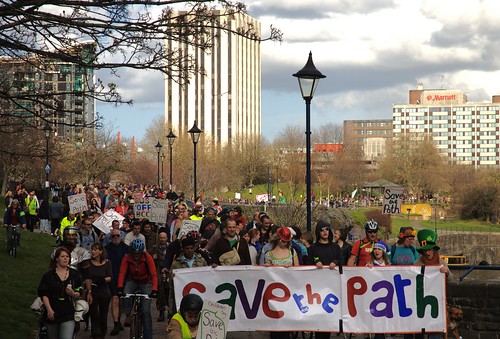
Back in March thousands of Bristolians were out making a public show of how much they loved the Bristol & Bath Railway Path. The most popular railway-to-path conversion in Britain, this path is said to attract 2.4 million trips a year on foot and on bike; walking to school, cycling to work, running for fitness, walking the dog, enjoying the greenery. The proposals to run Bus Rapid Transit down the path shocked everyone who used the path, who couldn't believe that their path, their park, was going to be taken away. Yes, a cycle lane would remain down the side of the path, but there would be little greenery, just concrete and buses.


We stopped it. Together, those thousands of people created the single largest on-line petition in Bristol's history, while the walk down the Path and College Green rally was one of the largest demonstrations the city has seen in the past decade -a friendly and peaceful day out for everyone involved. When the council leaders announced their change of heart, we all breathed a sigh of relief.

We breathed too soon. Because while the councillors were agreeing with us -the Railway Path is a special part of East Bristol- the council officers were talking to George Ferguson's architects and developer Squarepeg about building houses on the green margins of the Path up at the old Chocolate Factory site in Easton. This is a development where the community successfully prevented the previous developers from creating a featureless cul-de-sac of suburban houses, and we were all looking forward to the development. Imagine then, our surprise and disappointment when the proposal included building on the green margins of the path, with stairs to provide "bicycle access" to the path. Because as everyone knows: bikes and stairs are such a perfect combination.


Imagine our even greater surprise when the freedom of information requests gave us the email discussions going on behind the scenes, where we discovered that:
  1. Negotiations over use of the park land has been ongoing since March.
  2. Both the BRT planners and the Parks department said they needed the land
  3. One council officer, David Bishop, managed to fix things by overriding the other officers and the local Green Space strategy
Given that most of these 'cycle houses' will have steps to the path, they are more accessible by bicycle from the other side, from their garages. Why then has George Ferguson's team chosen to push anti-cycling houses onto the Bristol-Bath path? One email shows the reason: to add 25 more parking spaces.

For more information see:
Stop press....1.30 pm


Seeing red. George arriving late at the Watershed this morning for the 'this green and pleasant land' conference, only to be confronted by our leafletteer, publicising the Chocolate Factory controversy. His comment? "Go do something useful".

Sunday, 2 November 2008

From Park to Parking

The mass of Bristol City Council emails released last week following a Freedom of Information request includes many insights into how a section of the Bristol & Bath Railway Path came to be promised to Squarepeg against the initial advice of officers following the personal intervention of George Ferguson.

An internal email to the Strategic Director of City Development, David Bishop, dated 26th June, reveals that at the time Squarepeg had two development plans, one including the city council owned land that they coveted and another excluding it, in case they didn't get their way. A Portfolio Management Officer in the Valuation Practice of the Council emailed as follows-

I'm dealing with the possible disposal of land along the Bristol to Bath Cycle Path to Squarepeg. I am aware that you wanted to go over the proposals that Squarepeg had for the strip of BCC land within their developments prior to making any final decision on the disposal.

The attached plans show their proposals both with and without the BCC land, you'll see that without the land they will lose 25 parking spaces, part of the block of flats marked B, and a large access directly onto the cycle path.

It seems that the main difference that having the Railway Path land made at the time of the decision was that they could accommodate 25 more parking places (accounting for perhaps 250 square metres)! By comparison the land take for part of the block of flats would have been very small (20 square metres?) and the access steps from the Railway Path must be considered of dubious value for access from a path mainly used by cyclists (but more on that later).

So in essence the decision to sell part of the Railway Path green corridor appears to have been made to accommodate extra car parking! I wonder how those who support the Squarepeg plans feel about that?

Saturday, 1 November 2008

By George, what an operator!

Being one of the awkward squad gives an occasional insight into how deals are done amongst the Great and the Good. Back in the summer I started to publicly question the benefits of plans for 'Cycle Houses' alongside the Bristol & Bath Railway Path as part of Squarepeg's Chocolate Factory development at Greenbank.


It became apparent that the 'cycle houses' were to be built on former railway land that currently forms part of the green corridor of the Path. I sought clarification about the relevant land acquisitions from Squarepeg (via Jenny Gee of Interface) and received the following email from George Ferguson, the architect for the scheme and major league mover and shaker in Bristol and beyond, dated 1st September.
Hi Chris – you may be surprised to receive this from me but Jenny has asked that I respond.

1. The land you refer to does not form part of the green corridor of the cycle path but is in line with the land that formed the ownership of Elizabeth Shaw which is built right up to with brick and concrete walls. The land you refer to is in effect land that by chance ‘took a chunk out of the Chocolate Factory site.

2. The development boundary will be between 4m and 7m back from the cycle path – a good distance but close enough to give some natural surveillance.

3. There are no ‘front gardens’ to the cycle houses – but roof terraces. The houses will stand behind the wide verges but with ‘bridge access’ on to the edge of the path for occupants.

4. I am very aware of your opposition which has been noted and has been taken fully into account.

I have known you for long enough not to expect to change your entrenched views but your implication of ‘secrecy’ is total invention. I would just like to say that I have been so impressed with our clients’ attitude to this project which they rescued from the disaster that would have resulted from Persimmon’s plans. They are determined to produce an exemplary and viable development that has good green credentials and like me are not interested in ‘Greener than Thou’ competition but in real results. We have engaged with the community for months, have had an excellent working relationship and nothing has been hidden.

Maybe we should meet up for a drink - where do you live nowadays?

All the best – George

I responded on September 3rd, correcting some of his assertions like the bizarre suggestion that the railway "took a chunk out of the factory site" (the railway was constructed in the 1830s, half a century before the factory). But I ignored the invitation to "meet up for a drink". I guessed how personable and persuasive he might be in a social context so decided to stay at arms length. Others might have been well advised to do the same.

Anyway, having had his overtures to me rejected and following further embarrassing revelations, George fired off the following email (just released following a FoI request) to David Bishop, Strategic Director for City Development at Bristol City Council.


From: George Ferguson
To: David Bishop
Date: Tue Sept 9, 2008. 5.22 pm
Subject:Chocolate Factory

David – I gather there is a bit of stirring going on re the cycle houses. I think you probably realise that it is a load of nonsense and that we have all been extremely open throughout a very thorough consultation exercise, and have received overwhelming support from the community. It seems that Chris Hutt, who I know of old, and who even manages to wind up John Grimshaw and Sustrans, has been busy on the net and that a minority are now trying to make political mischief. It would be good to have the opportunity to talk before I disappear tomorrow afternoon for the Venice Architecture Biennale. I am so convinced of the merits of this scheme and have been impressed by the support we have had from your planning team.

All the best – George

George Ferguson PPRIBA
Chairman
Acanthus Ferguson Mann Architects

And we all know how accommodating David Bishop is being in ensuring that the Squarepeg Planning Application passes smoothly through the system, complete with a Planning Performance Agreement (which Squarepeg have cheerfully driven a coach and horses through) but without having to bother with anything as tedious as an Environmental Impact Assessment despite the obvious concerns about the development's environmental impact.

I shall be emailing John Grimshaw and Sustrans to see if they will confirm that I do indeed "wind them up" as claimed by George Ferguson.

Monday, 29 September 2008

Car park is "evil" - Ferguson

I have to admit that sometimes George Ferguson hits the nail on the head. So it is in his latest By George column in the Evening Post. Talking about the new Carboot Circus development Ferguson refers to the giant 2,600 space car park as "the necessary evil" to make the shopping centre work.


I'd have hesitated to go so far as calling a mass of steel and concrete "evil" myself, but then I'm not a famous architect. So thanks to George for reminding us what it's all about. Forget about Park & Ride, buses, walking and cycling - it's all about the 7-days-a-week influx of thousands of cars and having a really flash place to park them all.

2,600 is a hell of a lot of parking spaces (over 10 times what George manages to cram into his Chocolate Factory development). Even so my own casual observations suggest that for every car parked at some expense in the state-of-the-art multistorey car park there will be another parked for free in the streets of St Jude's and St Paul's. Residents of River Street are particularly hard hit, having the monstrous car park looming over them (below) and all the extra traffic noise and pollution blighting their lives, but also finding that they and their visitors will be lucky to find a place to park within walking distance.


Similarly cyclists find that places to park and securely lock their bicycles are few and far between at Carboot Circus. It seems that since they won't be able to carry as much useless, overpriced tat away with them compared to motorists they are not to be made welcome at the Cathedral of Commerce. Nevertheless some appear to be visiting (perhaps taking a break from the futile search for a safe and convenient way of cycling through or around a development which has obliterated so many formerly useful cycle routes) and have had to improvise when it comes to cycle parking.