Sunday, 28 September 2008

Is Nothing Sacred?

It's one thing for our new Big Brother organisation Carboot Circus, who've taken over control of some of Bristol's most historic public open spaces, to boot out riff-raff like smokers and bygone religious nutters, but now things have really gone too far. It seems that even Zombies are persona non grata down at Carboot Circus.


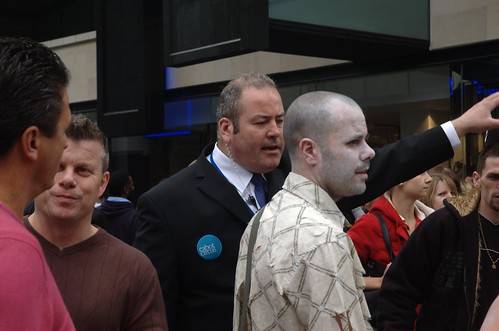
Yesterday morning a group of Zombies, who surely have as much right to enjoy the delights of Carboot Circus as anyone else, gathered in Castle Park (not yet under the auspices of Big Brother) and wandered down to the new Mecca* but were prevented from entering by "the men in dark suits" who normally lurk discretely but ominously in the background.


Presumably "the management" took the view that nothing should distract from the prescribed form of Mammon worship, although the Zombies own moral vacuity would seem to make them natural co-religionists. But such intolerance of even the slightest deviation from religious orthodoxy has always been the hallmark of religious sects reveling in their supremacy.

Thanks to Perlmonger for the pics.

(* just to be equally offensive to all religions. No discrimination here.)

Saturday, 27 September 2008

Quakers expelled from Quakers Friars

Just picked this up from a video link on Indymedia. Apparently some of Bristol's Quakers were distributing leaflets in Quakers Friars, where for 200 years they used to hold their meetings, to publicise a public meeting that they are organising to debate the impact of the new Cabot Circus shopping mall. This former public space has been privatised and is now owned by the mall developers who obviously took a dim view of freedom of thought being promoted in their private realm and "turfed" the Quakers out. Welcome to Carboot Circus.

Friday, 26 September 2008

The Mall Mentality

I came, I saw and I concurred - with most of what I and other bloggers had already written about Cabot Circus. It is indeed impressive in its scale and inspired in its design (but what do I know about architecture?*). I liked the way the middle street arrives at the circus at a higher level to the side streets, the way that the multiple levels give you so many different viewpoints and the way that it tries to blend in with the old Broadmead. It could easily have been worse.


Comments liking it to a Cathedral of Commerce were closer to the mark than I expected. In scale it is very cathedral like, and in the way that its aisles are lined with chapels to the various saints (saint starbucks, saint next, santa costa, saint yo sushi). Worshipers can make their votive offerings to their favoured saint, donating a few pounds here and there, very much in the Catholic tradition. Of course the major deities Jesus of Fraser and Harvey Virgin Mary take centre stage but most worshipers will feel that they have a more personal relationship with their own patron saint.

As I walked back home I was struck by how run down and neglected the older part of Broadmead now looked. And not just Broadmead but much of central Bristol now appeared tacky and uncared for by comparison. That worried me, because I've always felt that we should focus our efforts on making the public realm, particularly our main streets, more attractive as places to be, less dominated by traffic and better cared for. Yet the initial impact of Cabot Circus seems to be to make the public realm look even more squalid.


Cabot Circus is essentially a shopping mall, albeit with a more porous perimeter in the Broadmead direction. The essence of a mall is that within it you walk in a pleasant environment, weather free, traffic free, noise and pollution free, untroubled by undesirables like beggars and muggers. But outside the environment is actually degraded by the mall. Not only are vast areas and/or resources given over to car parking but the traffic generated by the mall dictates that the surrounding area must be dedicated to accommodating that traffic.

Contrast this with the traditional shopping street like Gloucester Road or Whiteladies Road. Such streets are multifunctional and messy but organic. They have grown without any significant planning as a result of thousands of individual actions. Small local businesses can flourish because within the unplanned complexity they can find a niche that suits their scale. There's no place for such small businesses in Cabot Circus and the future prospects of traditional shopping streets can hardly be improved by the arrival of the brash big brother down the road.


Cabot Circus, we are told, has created 4,000 "new" jobs. Does that include jobs with House of Fraser and others already based in Bristol who have merely moved eastwards? Even those jobs that are genuinely new to Bristol may well be at the expense of other jobs in existing businesses that fail or have to scale back as a result of the competition from Cabot Circus. Or are we all suddenly going to spend so much more money, in the teeth of a recession, that the 4,000 jobs really will be in addition to what already exists?

According to the Evening Post the "greatest threat to Bristol's new city centre appears to come from ... a small minority who appear to have a perverse desire to see Cabot Circus fail". Something of an overstatement I think, but they are clearly referring to bloggers such as me and the Bristol Blogger. In an emotional piece worthy of Churchill railing against the nazi bombers of 194o, the Post refers to our "doom-laden cynicism". Fair comment, but in the end we need a rational debate about the impact of Cabot Circus, not the Spanish Inquisition headed by Mike Norton.

(*answer - about as much as George Ferguson knows about planning for cyclists.)

Thursday, 25 September 2008

The Circus comes to Cycling City

There's no question that Cabot Circus is having a profound affect on Bristol. The sheer scale of it is impressive and its prominent location at end of the M32 will mean that it is the first major building complex that most visitors to the city will see. Above all it will change the image of Bristol, although whether for good or ill is, of course, debatable.


It defines Bristol as a centre for conspicuous consumption, inviting the wealthy denizens of the the west country to drive in on the M32, sweeping majestically over the impoverished masses of Bristol's east end, and into what must be one of the world's most inviting multi-storey car parks, to choose from no less than 2,600 parking bays. From there it is but a short stroll via a private bridge (still hermetically sealed against the edgy urban environment below) straight into the heart of the new cathedral of commerce.


Once inside our wealthy visitors will of course find themselves rubbing shoulders with the hoi polloi, to give that authentically urban experience, but they can rest assured that these "streets" remain in the private realm, closely monitored to exclude any undesirables. As they saunter towards Harvey Nicks they will briefly have to cross a real public street, with real traffic, before reaching another privately controlled enclave at Quakers Friars. Perhaps that brief exposure to reality will give them the confidence to proceed further into the city, perhaps not.

So much for the wealthy, but how will Cabot Circus impact on the rest of us, on Bristol's growing band of cyclists for example, who once enjoyed some useful links through this area before all was swept aside for the new consumer complex. Has the massive investment of £500 million, including a complete reworking of the local highway network, resulted in some outstanding new cycle paths, allowing us our share of "sweeping majestically" past the congested traffic?


Sadly not. Admittedly there is a solitary cycle lane in one direction down Bond Street to lead unsuspecting cyclists towards the new gyratory system called Newfoundland Circus, but just when you really need to have a well defined safe route through the chaos of conflicting traffic movements the cycle lane, in typically Bristol fashion, ends abruptly (above). Cyclists then find themselves 'merging' with the adjacent traffic lane (below) without any indication of who should have priority. In short a death trap.


Cyclists are left in limbo, some struggling on trying to weave their way through the multiple traffic lanes, others opting to take to the pavements where pedestrians will inevitably be made uncomfortable, to put it mildly, by the presence of cyclists without any provision being made for segregation. Shared use is fine in principle but in confined spaces with heavy and conflicting flows of both pedestrians and cyclists it really isn't suitable.


Even the planners seem to have been unable to make up their minds where cyclists should be taking their chances. Odd fragments of cycle lane and advanced stop lines suggest cyclists should be on the road, but very small, almost apologetic blue signs on the pavement lampposts confirm that cycling on them is not actually illegal and the pedestrian crossings are all shared use. The result is that cyclists (and other road users) remain unsure of their status whichever option they choose. The worst of both worlds.

Cynics like me will not be in the least surprised by any of the above, but Newfoundland Circus must be a bitter pill to swallow for those who still cling to the notion that Cycling City status is going to transform things in favour of cycling. The same bunch of anal inadequates behind the pathetic "cycle provision" around Newfoundland Circus are now formulating the measures designed to supposedly boost cycling to double the number of journeys. Welcome to Cabot Circus.

Monday, 22 September 2008

Interfering Interface

It seems that Squarepeg's greenwash and marketing consultants, Interface, fronted by Jenny Gee, didn't like their products being given free publicity on this blog yesterday.

My last blog post revealed the type of marketing products more commonly produced by Interface, who've recently been putting on a very plausible green face for the purposes of selling the idea of building houses along the embankment of the Railway Path at Greenbank.


My blog post included several links to images on web pages included in the Portfolio section of Interface's website. But this evening I find that all the links have been cut by Interface, presumably in a fit of pique. It seems they'd rather you didn't know that their run of the mill products are glossy brochures, junk mail and excess packaging of the sort that we all so roundly despise.


So let the web wars commence. My retaliation is to copy these images to an independent site where, hopefully, they won't be able to get their coffee stained little fingers on them. So once again you can feast your eyes on the products of the creativity of Interface. I can't imagine what they were so ashamed of, can you?


Of course declaring web war on a company that claims to specialise in software development might seem rather rash, but if their software competence is anything like their PR competence then I reckon I'm on safe ground.