Showing posts with label Department for Transport. Show all posts

Monday, 16 February 2009

New Threat to Railway Path

You might think that being designated Cycling City might persuade Bristol City Council to take some pride in the success of the Bristol & Bath Railway Path as a long distance cycling route and the valuable contribution it makes to accommodating peak commuter flows in our congested city. But it appears not....


They are now proposing to introduce "traffic calming" on the Railway Path, in association with the current proposals to redevelop the Chocolate Factory at Greenbank. Followers of this blog will know well enough the long-running sorry saga of the Chocolate Factory and George Ferguson's attempt to squeeze a narrow terrace of housing onto the bank of the Railway Path under the guise of "cycle houses" and the clandestine land deal hatched between Ferguson and planning boss David Bishop.



The houses are proposed to open onto the Path with individual accesses so implicitly making claim to the Path as their communal "front garden", so cunningly avoiding the developer having to provide the land for this. But of course this sets up conflict between residents who will view the space in front of their houses as their "front garden" where their children can play and cyclists who view the Path as a relatively fast commuter route.


Having planned to set up the conflict in the first place the Council now seek a way to resolve it, hence "traffic calming" on the Railway Path. According to the report to Wednesday's Development Control Committee " ... the applicant (Squarepeg) has offered £130,000.00 for traffic calming on the surrounding streets and railway path.

The Parks Services Manager has more to say on the issue
"We would like to see a creative design for the length of the path affected by the development, so that it is treated as shared space so that visitors can be encouraged to stop, picnic etc, but also most importantly to calm cyclist speeds. There are ways that this can be achieved without imposing an urban feel and losing the intrinsic naturalness of the path experience....."

"I am comfortable in taking forward plans to calm cycling speeds along the railway path and to manage this as any capital project in a park – including public consultation and capital delivery. We have capacity to do this.”
So our Cycling City think they "have capacity" to traffic calm the Railway Path. Is this the same Cycling City who cannot organise basic maintenance without causing serious injuries to cyclists, the same Cycling City who cannot design a cycle path without creating blind corners (Clay Bottom) that cause serious injuries to cyclists, the same Cycling City who cannot resolve security issues that result in violent attacks on cyclists, the same Cycling City who still harbour ambitions to turn the whole Path into a concrete track for buses? Yes, the very same.


Those of us who have the misfortune to live in the real world rather than the Cycling City Corporate Fantasy World may recall the disastrous consequences of previous attempts to "traffic calm" the railway Path in the Kingswood area in the 1990s. Illegal speed humps, bollards and chicanes were all tried and several cyclists were injured as a result, resulting in successful damages claims being brought against Kingswood Borough Council (although there was no significant impact on speeds). Most of these ill-conceived attempts at traffic calming have since been removed.
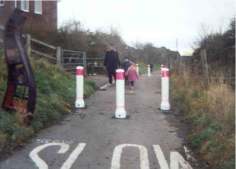


Were the Railway Path a road the average speeds recorded would not be considered sufficiently high to justify any traffic calming at all, even if a 20 mph speed limit were to be adopted. Yet the Path is not designated a public highway and users do not enjoy the protection of Department for Transport regulations. So incompetent officers are free to experiment with half-baked notions of what might "calm" cyclists, putting our lives at risk.

Sunday, 8 February 2009

Traffic in Decline

For the first time in 30 years road traffic is in decline, according to the latest data from the Department for Transport. The decline began last Spring but was particularly marked (2.2% down) in the Summer in response to rocketing fuel prices. However the decline has continued through to the end of 2008 despite fuel prices dropping back, due to the recession. All this is against an expected growth in traffic of between 1% and 2% a year.


Road deaths have also fallen by more than 400 to 2,610, about 5 times the usual annual decrease, although deaths of cyclists have increased. New car sales have slumped, over 30% down. In Bristol and other cities congestion has decreased by 5% (in terms of time wasted in congestion). Traffic on urban roads has decreased by about 1% compared to the previous year. The expectation must be that traffic levels will continue to decline as the recession develops, due to declining employment and discretionary expenditure in general being cut back.

Most of which is good news as far as I'm concerned, except of course for the increased death rate for cyclists. That is likely to reflect a sudden influx of novice cyclists who haven't yet developed survival strategies (like jumping red lights) to the extent of experienced cyclists. But leaving that aside, things are looking good from an environmental perspective. Of course the recession won't last forever but it gives us a breathing space to explore the potential for reducing our car dependence.

Yet Bristol City Council are still wedded to transport priorities based on the assumption that traffic growth will continue relentlessly into the future. Strategies for accommodating traffic growth like Bus Rapid Transit and Congestion Charging must be called into question. Much of the financial "justification" for public transport subsidy, such as the proposed expenditure on BRT infrastructure, is based on the time savings accruing to motorists as a result of reduced congestion. But if congestion is reducing anyway......

Sunday, 11 January 2009

How Much is a Life Worth?

I've decided to gen up on the whole 'road safety' issue in preparation for some searching questions about why so many people are getting killed and injured on our roads here in Cycling City. As you might expect it's not the most engaging reading and one suspects that it is presented in as dry a way as possible to avoid emotive responses. A road safety vocabulary and jargon has evolved to avoid terms like killing or maiming or crippling. Instead they talk about fatalities and KSIs (killed and seriously injured).


Despite the jargon there's much food for thought there. One thing that struck me as particularly curious is how they value of a person's life or well being is determined in order to show whether road safety measures are justified or not (I did say it was dry stuff). You may shudder at the thought of your life being so precisely valued, but it would be stupid to spend say £1 million on a measure likely to save one life every ten years and then have no funds left to spend on another measure that would save one life per year, so it seems these sorts of calculations have to be made.

So we find under the Road Safety Economics heading of Bristol's Road Casualty Review that the Department for Transport give us figures for the value of saving a life which vary according to the type of road. On urban roads a life is worth £1.55 million but on a motorway a life is worth £1.75 million - 13% more. The difference is even more pronounced for slight injuries, worth paying £18k to avoid on urban roads but almost £26k on motorways - 41% more.


Why is the health and safety of motorway users worth so much more than users of urban roads? Could it be that people killed or injured on urban roads are more likely to be pedestrians or cyclists rather than motorists? Are the lives of pedestrians and cyclists judged to be worth less than those of motorists, perhaps because they are likely to be less economically productive? I've some more digging to do on this, but I don't like the sound of it one bit.