Saturday, 28 February 2009

Signs of the Times 2

Bureaucrats do like their signs and none more so than Bristol's Harbour Master, whose offices are in the Underfall Yard at the western end of the Floating Harbour. Some think it's all getting out of hand, expecting people to blindly follow written instructions without regard to reality, but I suppose that is exactly how bureaucrats conduct their lives.


Despite the speed limit of 5 mph, barely more than walking pace, the Harbour Master has nevertheless gone to the extraordinary length of marking out the prescribed pedestrian route through the yard with yellow hatching! It seems nothing must be left to chance in the Harbour Master's domain.


How else would we know not to go swimming in the inviting blue waters, or not to walk off the edge of the quayside? Think how many lives have already been saved by these vitally important signs. How fortunate we are in having such a diligent Harbour Master.


I suppose the 5 mph speed limit is required to allow time to read all the signs. But what is this? Do we see signs of dissent within the Harbour Master's dominion? Or has this recycling bin been allocated for Bristol's erstwhile Labour Cabinet?


PS> For more bureaucratic signage bollocks check Bristol Traffic.

Tuesday, 24 February 2009

Lib-Dems bounced into power?

This evening's budget debate at Bristol City Council has upset the apple cart. The Lib-Dems have secured Conservative support for their budget amendments, defeating the budget of the minority Labour Cabinet. A particularly critical element of the Labour budget concerned the proposed incinerator favoured by Labour but fiercely opposed by the Lib-Dems. The successful Lib-Dem amendment said
No Incinerator: suspend any spending on phase 3 of waste procurement, with the aim of reaching consensus on phase 3 across all four authorities (£389,000)
The Labour Cabinet have decided that they cannot continue administering what has effectively become the Lib-Dem Budget and have resigned. the ball is now in the court of the Lib-Dems who, as the largest group, will be expected to form a new Cabinet. This follows a series of recent decisions by the Lib-Dems not to take control despite the withdrawal last year of Conservative support for the Labour Cabinet and even a motion of no-confidence in the Labour leader Helen Holland (below) tabled by the Tories earlier this month.


So it seems that the Lib-Dems may have been bounced into taking control of the council in the run-up to June's Council elections, something the Tories presumably wanted for political reasons (the Lib-Dems being their principal electoral rivals) and something the Lib-Dems didn't want, since the incumbent Party is bound to be associated with the many unpopular policies being pursued by the Council.

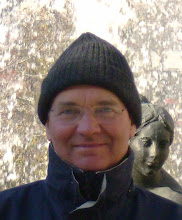
All is yet to be revealed, but did the Tories vote in support of the Lib-Dem amendments to achieve this outcome? Did the Lib-Dems know where it would lead? Were Labour in on it, indicating to the Tories that they would resign if the Lib-Dem amendment was successful? Will the Lib-Dems take control under their Leader Barbara Janke (below) or will they hold out for a coalition with another Party so as not to appear to be The incumbent Party in the run-up to June's elections? (see * below.)


Thanks to the diligence of James Barlow in following the web cast and breaking the news.

*The Bristol Blogger says that Barbara Janke's has been voted in as the new Leader. Later edit - this is confirmed by several sources. Post report here and BBC here.

Monday, 23 February 2009

Bristol European Green Capital - Not

Bristol City Council's bid to be awarded European Green Capital status has failed, with Stockholm and Hamburg winning through to be appointed European Green Capitals for 2010 and 2011 respectively. No doubt the Council will put a brave face on it and stress that they're still in the running for 2012 onwards. They've got a long way to go to be a credible candidate.

Monday, 16 February 2009

New Threat to Railway Path

You might think that being designated Cycling City might persuade Bristol City Council to take some pride in the success of the Bristol & Bath Railway Path as a long distance cycling route and the valuable contribution it makes to accommodating peak commuter flows in our congested city. But it appears not....


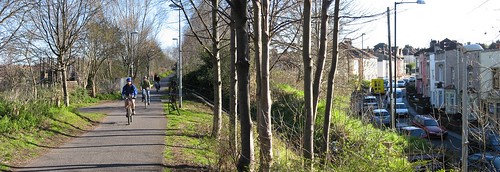
They are now proposing to introduce "traffic calming" on the Railway Path, in association with the current proposals to redevelop the Chocolate Factory at Greenbank. Followers of this blog will know well enough the long-running sorry saga of the Chocolate Factory and George Ferguson's attempt to squeeze a narrow terrace of housing onto the bank of the Railway Path under the guise of "cycle houses" and the clandestine land deal hatched between Ferguson and planning boss David Bishop.


The houses are proposed to open onto the Path with individual accesses so implicitly making claim to the Path as their communal "front garden", so cunningly avoiding the developer having to provide the land for this. But of course this sets up conflict between residents who will view the space in front of their houses as their "front garden" where their children can play and cyclists who view the Path as a relatively fast commuter route.


Having planned to set up the conflict in the first place the Council now seek a way to resolve it, hence "traffic calming" on the Railway Path. According to the report to Wednesday's Development Control Committee " ... the applicant (Squarepeg) has offered £130,000.00 for traffic calming on the surrounding streets and railway path.

The Parks Services Manager has more to say on the issue
"We would like to see a creative design for the length of the path affected by the development, so that it is treated as shared space so that visitors can be encouraged to stop, picnic etc, but also most importantly to calm cyclist speeds. There are ways that this can be achieved without imposing an urban feel and losing the intrinsic naturalness of the path experience....."

"I am comfortable in taking forward plans to calm cycling speeds along the railway path and to manage this as any capital project in a park – including public consultation and capital delivery. We have capacity to do this.”
So our Cycling City think they "have capacity" to traffic calm the Railway Path. Is this the same Cycling City who cannot organise basic maintenance without causing serious injuries to cyclists, the same Cycling City who cannot design a cycle path without creating blind corners (Clay Bottom) that cause serious injuries to cyclists, the same Cycling City who cannot resolve security issues that result in violent attacks on cyclists, the same Cycling City who still harbour ambitions to turn the whole Path into a concrete track for buses? Yes, the very same.


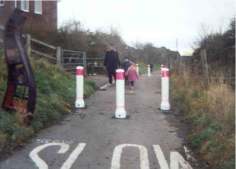
Those of us who have the misfortune to live in the real world rather than the Cycling City Corporate Fantasy World may recall the disastrous consequences of previous attempts to "traffic calm" the railway Path in the Kingswood area in the 1990s. Illegal speed humps, bollards and chicanes were all tried and several cyclists were injured as a result, resulting in successful damages claims being brought against Kingswood Borough Council (although there was no significant impact on speeds). Most of these ill-conceived attempts at traffic calming have since been removed.


Were the Railway Path a road the average speeds recorded would not be considered sufficiently high to justify any traffic calming at all, even if a 20 mph speed limit were to be adopted. Yet the Path is not designated a public highway and users do not enjoy the protection of Department for Transport regulations. So incompetent officers are free to experiment with half-baked notions of what might "calm" cyclists, putting our lives at risk.

Tuesday, 10 February 2009

Cars have their uses

Recent weather events remind us that cars have their uses in helping to keep highways clear of obstructions and debris of one sort or another. In freezing weather conditions cyclists are best advised to stick to the roads and give cycling facilities a miss because the roads will generally be salted and kept clear of snow and ice. But this is not entirely the consequence of the Council's road maintenance priorities being focused on motor traffic. The traffic itself helps to keep the roads clear by displacing snow, slush and water from the road surface.


Thanks to the Council's misguided attempts to encourage cycling we have a neat illustration of this at Prince Street Bridge (which some of you will have noticed is a bit of a cause célèbre on this blog) as pictured above and below. In the first we see how snow and slush collect on the motor traffic free side (left) compared to the side still used by cars (right) where even the footway is clearer. In the second we see that heavy rain leads to the creation of large areas of standing water on the motor traffic free side (left) but none on the side used by cars (right). In either case it would only require freezing temperatures overnight to turn the standing water or slush to ice to make the surface deadly dangerous.


Standing water on the streets seems to have become a prominent feature of Bristol from about the time that Avon County Council was abolished 13 years ago. I guess a generation of old style highway engineers, who foolishly thought their main responsibility was maintaining the highway infrastructure, disappeared along with Avon and were replaced with aspiring social engineers more interested in how they can bamboozle us into changing our individual behaviour to fit in with their targets for modal shift. Anyway, here's a long standing (well over 10 years!) seasonal body of water, Lake Pembroke (area 21 square metres), to be found at the junction of Pembroke Road and Queen's Road in Clifton.


Picturesque though Lake Pembroke is, passing traffic causes waves to wash across the western shore, totally inundating what vestiges of the footway remain above high water level, so soaking any pedestrians unfortunate enough to be passing. The remedy is of course to unblock the drainage gully located at this point, but that would involve someone from the Council having to leave the comfort of their nice warm dry offices to have a look and actually risk getting wet, which would really be asking to much of the poor dears.